Sunday, October 30, 2011

It is cold and it is TIME!

Uh Oh... cold weather means the end of greens and time to start butchering. Geese and Ducks are first on the chopping block. Turkeys get a couple more weeks.

Butchering is not my favorite part of poultry raising. This is not because I really care about death (I raise them to eat them). It is more a matter of it is messy and tedious.

We had never raised or butchered water birds before. It is kind of cold so we beheaded the geese and let them bleed out upside down on the fence. Then we brought them inside for plucking and cleaning (not the best idea but it is 20 degrees outside). We did them one at a time. Each took about an hour start to finish and it is so tedious we wound up only doing the two voracious geese today. We will probably do turkeys next week and then we shall see about the ducks (I moved them to the chicken coop...kids lost one in the move and are still outside looking for it. It is one of my Khaki Campbells, which are the egg layers! If I only winter over two it would be those two. My stinkers better find her!)

My hubby put what he calls the "bird hook" in the middle of a door frame and we hung the bird upside down by its feet over a tote for plucking. I first dunked it in a stock pot of hot water to help loosen the feathers.

After plucking we used a torch to singe off the last of that downy under fluff and a few stray feathers (set off our smoke alarms...which is exciting because I bashed a couple off the ceiling in a rage while making toast and I was not sure we had any working ones left.)

After torching we gutted the birds and then put them into a cold salt bath. I saved the livers, hearts and gizzards. I'll try pate later.

Sunday, July 3, 2011

Homebodies

GRRR!!!! I decided to huff it out to the pond with the ducks and geese so they could swim. If you have never walked across squishy tundra with thigh deep grass and shrubs...it is HARD work. I carried them out two at a time and each time three of them found each other the little stinks ran all the way back to the yard.

So much for worrying about not being able to get them to come home.

One group even came up the ditch between us and the neighbor's, looped around the front of the house, walked over the dirt pile and rendezvoused with the other birds in the back yard.

So now I am tired and just have to worry about keeping dogs out of the yard. Jinx must have a little of some kind of herding dog in her gangsta-mutt mix. She was the only one having a good time with all of this.

Friday, July 1, 2011

FREEDOM...for 30 minutes

The Ducks and Geese are HUGE and they poop a lot. I am still going back and forth about sending them out to the pond behind our house. It is a bit of a hike and I am afraid I will never be able to get them to come back. The pen they are in is getting increasingly smelly and muddy though so I need to make a decision one way or the other.
I let them get a taste of yard life tonight and it was not as crazy as I thought it would be. Our dog was fascinated and the geese did not care for her curiosity one bit. Too funny. I am in love with the hissing, wing waving geese. They are the BEST and the ducks just follow them around like they are the group bodyguards.

All the birds were so happy to be out and about and ate grass until they were bloated. I was really impressed that I managed to herd them back into their pen too. Not nearly the crazy scene I expected. Unfortunately this was probably because the kids and hubby were washing my truck (my truck has a sticker that reads "Do Not Wash: Conducting Scientific Dirt Experiment)...my truck was even nasty by my standards so it took them a while. I think the lack of screaming girls helped me calmly shoo them back to the pen.

I am debating between trying to teach them to come back to the pen with treats for a couple days or just turning them loose on the pond with the notion I will figure out how to get them back at the end of the summer...smart or lazy....hmmm.

Strut your stuff...turkey style


We got home after an eight day trip and before we even got into the house the girls were squealing about how big the turkeys had gotten. They nearly doubled their size in just over a week. Not the freak of nature growth we saw in the water fowl, but impressive all the same.

Turkeys are dumber, yet more personable than chickens. I think it is because they are hungrier since they are growing so fast. Whatever the reason they run to you the second they see you... sort of like obnoxious dogs. It is kind of hard to get them to leave you alone.

We have two that survived that early run of chick loss and they are frenimies. I catch them pecking at each other and picking their heads raw. But they are also always together and never out of each others sight. I am loving the mini-loud and proud displays the white one keeps doing. I can't wait to see him at it when he weighs 25+ pounds. The antics are just going to make him taste better...mmmm turkey!

Tuesday, June 21, 2011

Tropical Chickens??

We are in beautiful Kauai for the next week or so. I saw comments as I was planning from people complaining about chickens on the island. I figured it would not bother us in the least.

I had no idea!!! They are EVERYWHERE!!!

It is like our yard took over an island. They are more prevalent than squirrels in Florida. It is a hoot.


We definitely picked the right island and as we are stuck in slow traffic we shout out "chickens" every time we see one...it is sort of like a chant.

My hubby does now question the source of all chicken we eat in restaurants. I assure him that roadside chicken would surely be tougher than what we are eating. He is still dubious.

Love it!

Saturday, June 18, 2011

Perennials -- a lazy gardeners best friend

Perennials are plants that come back every year without replanting. Once frost gets a tomato plant it is gone forever. Perennials die back and then magically reemerge in the spring. Awesome Opossum.
The fun trick for us out here in the bush is that it is really hard to find plants that actually will come back We are a zone 2-3 which means we have really cold winters where temperatures drop to -30 (not talking wind chill, I mean straight up -30). It is also windy and in recent years we do not get the snow cover we used to. Snow can act like and insulator to protect plants from a quick dip to crazy cold temperatures. We are also on permafrost (a frozen layer of soil/ice a few feet below the surface). Permafrost keeps the ground from ever truly warming up. Our soil is also silty, lacks much organic matter, and is usually acidic.

To sum it up we factor in the following...
Short growing season (rules out most fruit trees because they cannot grow fast enough)
Crappy soil (acidic glacial silt)
Cold soil (we sit on permafrost)
Cold winters (can kill off most perennials)

I love perennials. We have to do so much to garden that it is nice to have some sure things that I know will just grow no matter what. While options are limited I do have a couple tried and trues. I also invest a little each year and try out new plants each year.


      (Three of my rhubarb plants 3 weeks after our last frost...and I love my view)

Rhubarb is of course the easiest sure bet. I did a whole post on them. They grow in pretty much any soil. They are the first thing to come back. Most importantly they are BEAUTIFUL and tropical looking. Nothing else gets that big and green. The fact that they have full leaves out the second the snow melts is a bonus. 

Our family favorite plant is raspberries. Early in our gardening we made a raised bed just for raspberries. It took off like crazy. We loved it so much we decided to expand the bed. Since then we have not had the same success we used to. I have been adding root stock every year for the past 4-5 and we only get a couple plants to come back each year. I have found that Latham Raspberries are the variety that does best for us with our climate and conditions.

Raspberries are thorny and weed-like.You get berries off the stem once. While it is fruiting it sends off shoots that sprout up near it. The next summer those will be your berry producing shoots and this years stems will die off. I have heard that you are supposed to cut all the stems back to the ground each fall. I don't do it because I think they need the slight head start. I just cut back the dead stems at some point in the summer and leave the shoots. I don't weed much around them and just let them do their thing. This year we put a couple root stalks along the edge of the garden slope to see if they will take off there and give a little stability and barrier to the edge of the plot. If I try a different variety of raspberry I always go for the "early" producers. We still don't get berries until August.

Of all my "experimental" plants I have tried Currants have turned out to be the best. I have had this plant for 4-5 years and it comes back early and pretty every year. It is the first to flower and get fruit going. I think I may invest in a couple more. Currants make nice jam and wine. I only have this one plant so we really don't do much with the fruit, but if I get a couple more I can really have some fun with them.


Strawberries have been hit or miss for us, but I know a lot of people who have them come back like champs every year. I started planting them along the bottom of my garden slope a couple years ago where they stay nice and wet (my slope wicks up water from the pond at the base) and it is sunny. I had them coming back and then this year we accidentally buried them when we moved some beds to the base of the slope. I will get some more going next year. I usually go with a mix of early producers. I think I did Ft. Laramie and Honeoye.


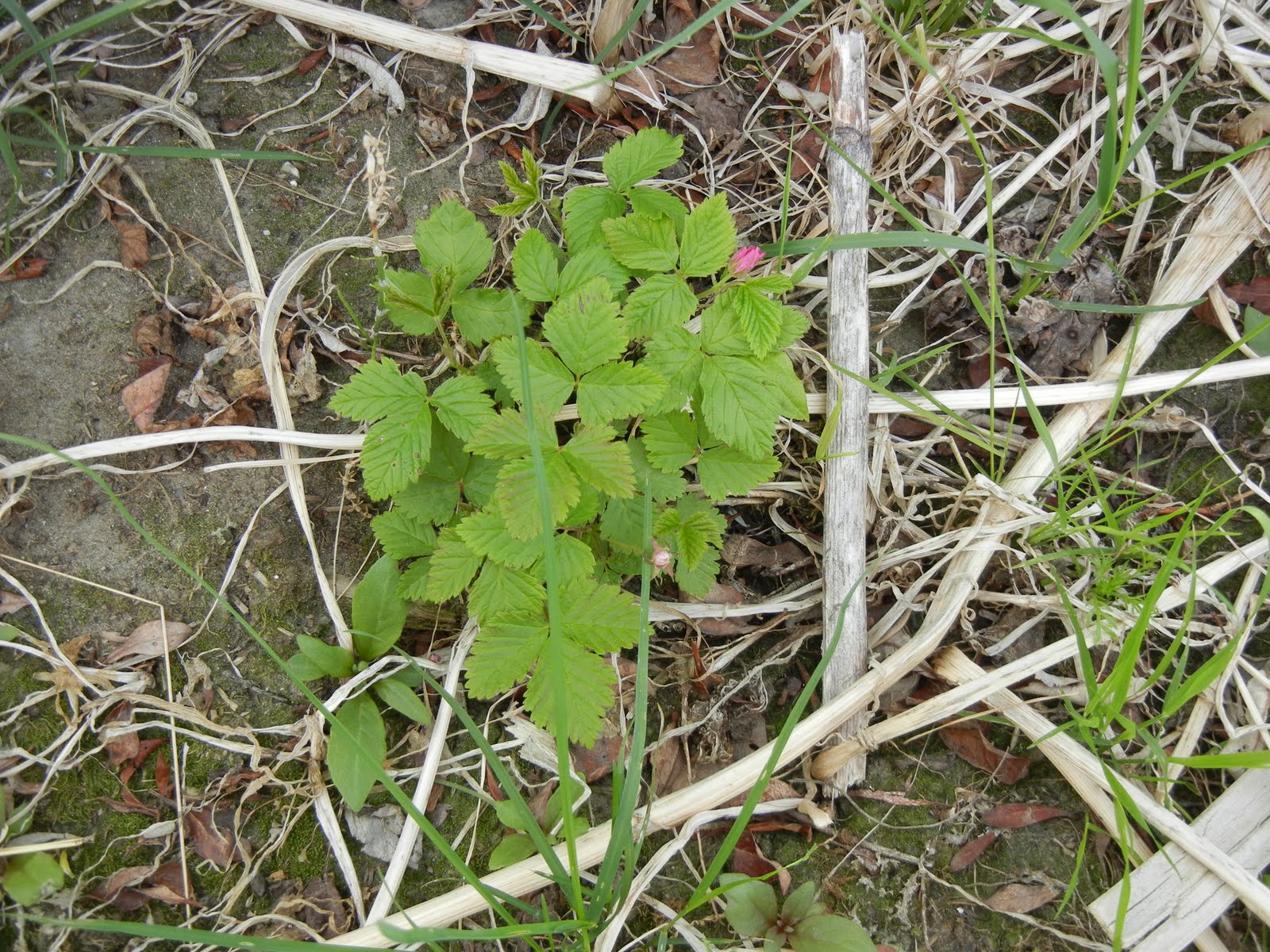
Some of our experiments have been to transplant local plants to our beds. Our favorite local berry (berries grow like crazy on the tundra) is one called a Nagoon Berry. Raspberries are my hubby's favorite and these little stinkers are like raspberries on steroids. You can mix a handful of these with a quart of another berry and all you will taste is the Nagoon. My other theory is that they taste better because they are such a pain in the rear to gather. They grow under grass  or back in willow thickets. Basically you are crawling around on the ground in the buggiest spots you can imagine and they are small so a lot of work only nets you a few berries. We now have two spots where these are growing in the yard. I plan to try to expand. They grow one berry on a single stem sort of like a strawberry or salmonberry. The plants do come back but do not always produce fruit and we don't know why. They make pretty green ground cover with dark pink flowers and since they are local they should grow without much messing around with the soil too.

Failed experimental plants have included wild grapes (came back one year but never produced fruit), many varieties of mongolian/siberian/russian apricots/crab apples/choke cherries (you get the picture), blackberries, gooseberries, & non-local blueberries. I have four fruit tree starts out there this year and they are leafing up. They always leaf up the summer I plant them. They are right next to the dead weeping willow and siberian choke cherries from last year. There is some saying about learning from our mistakes...maybe one summer I will run into another gem like my currants though so I keep trying.

I have friends who have had luck with some local irises and some bulb flowers. I usually only mess with stuff I can eat so I have never gone there. I do have a couple bulbs I am trying this summer because my girls wanted more flowers. They are coming up and are a zone 2, but only winter will tell if they make it back or not.

Sunday, June 12, 2011

For the Love of Rhubarb

Rhubarb is the best, most prolific, a monkey can do it, perennial for our harsh climate. I swear the second the snow melts I can see the plants getting ready to leaf up. The plants have big tropical giant leaves and are so pretty in a yard....especially a yard surrounded by tundra.

I decided to make a rhubarb fence a couple years ago and it is getting better each year. The back of my lot is lined with lush big leafed plants that I harvest and harvest and harvest. It is the first thing people comment on and they are dumb-dumb easy to maintain.

Basically you just plant a bulb-like start and they grow and grow and grow. Mine grow in crappy glacial-silt sand. I have one runty one but the rest are fabulous. Every year (or two) you can/should divide the "heads" with a shovel. You can see the divider spots and it is seriously hard to kill them once they are established. If you don't use a shovel to take off a couple heads every 3-4 years it can kill off the plant.

I have, and you can, start them from seed. It is slower going though. It takes about two seasons to get them off and running. I have had lightening in a bottle results with established roots that you can just plant straight away. 

The first year you should not harvest anything. Then the sky is the limit. In my short growing season I can usually get 4-6 harvests per year. I typically do not take all of the leaves at once. I more or less "prune" the plant. When it is getting cold and frost is eminent I take them all.

With Rhubarb only eat the stems. The leaves are actually poisonous. I turn the leaves into organic pesticide. They really are the best, easiest, most under-utilized plant in the gardening world.

My favorite use of rhubarb is a raspberry rhubarb pie with streussel topping. I usually don't use recipes but I will try to make one and post it at some point. Mine are kind of tart and I use coconut milk instead of butter. Yum!